
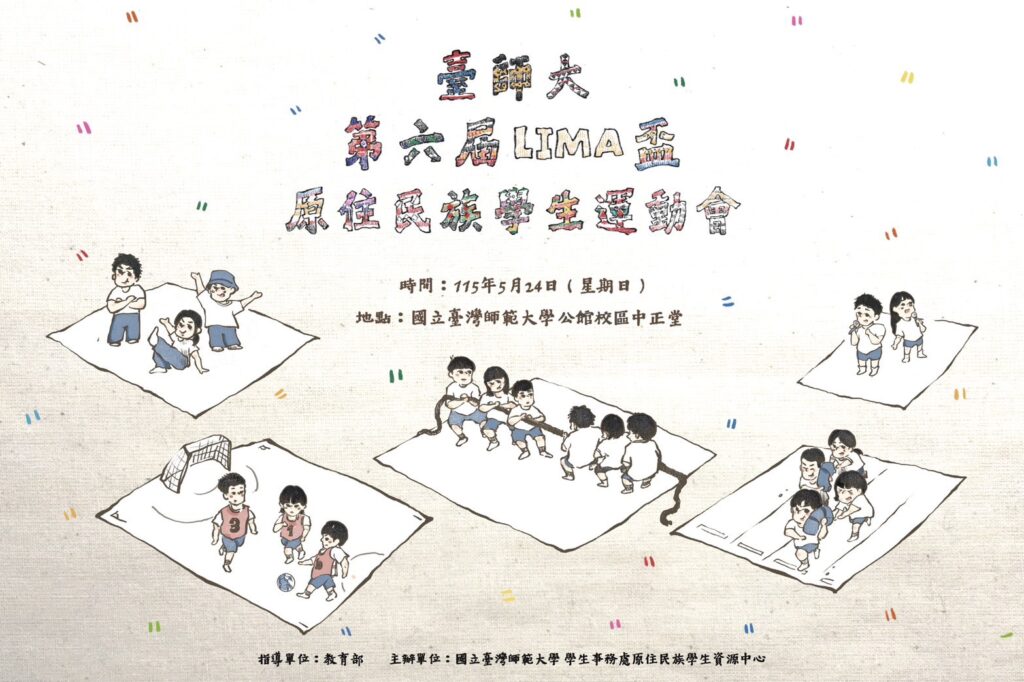
NTNU Hosts the 6th Lima Cup: Indigenous Youth Strengthen Bonds Through Sports, Music, and Dance
The 6th Lima Cup Northern Indigenous Student Sports Meet at National Taiwan Normal University (NTNU) kicked off on May 24 at the Chung Cheng Hall of the Gongguan Campus. Students from NTNU, National Taiwan University of Science and Technology (NTUST), National Taiwan Sport University (NTSU), and Lee-Ming Institute of Technology gathered for a day of competition and cultural exchange. In addition to traditional events such as five-a-side soccer, tug-of-war, and weighted relay races, this year’s Lima Cup introduced singing and dance competitions for the first time, providing Indigenous youth with opportunities to express their cultural identity through Indigenous languages, music, and dance. The event thus evolved beyond a sports competition into an important platform for cultural exchange and community building.
According to Mr.Huang, Director of NTNU’s Indigenous Student Resource Center, this year’s Lima Cup expanded beyond athletic competitions to include singing and dance performances, Indigenous-inspired handicraft experiences, and cultural activities. He explained that the term “Lima” means the number “five” in Austronesian languages and symbolizes “opening one’s hands to embrace one another.” Through sports and cultural interaction, the event aims to strengthen connections and friendships among Indigenous students in northern Taiwan.
From Flower Crowns to Handicrafts: Bringing Indigenous Culture into Everyday Life
The event’s chief coordinator, Miss Hong, a Paiwan student from Lili Village in Chunri Township, Pingtung County and a senior in NTNU’s Department of Physical Education and Sport Sciences, shared that moving away from her tribe to study in northern Taiwan deepened her appreciation for mutual support among Indigenous students. To foster a welcoming atmosphere, this year’s event incorporated flower crowns as a greeting tradition so that students from different universities would immediately feel welcomed and blessed upon arrival.
“Flower crowns are more than decorations—they symbolize blessings and companionship,” Hong explained. She hopes these cultural details will help participants reconnect with and better understand their own heritage.
The Lima Cup also invited Shanyuhai Studio to participate, showcasing jewelry that blends traditional Indigenous cultural elements with modern design, bringing Indigenous culture into daily life. Creator shared that hearing elders lament the gradual disappearance of Indigenous culture inspired her to preserve traditions through innovative approaches, while helping younger generations appreciate Indigenous aesthetics.
Vice coordinator Mr. Hushi, a Truku student from Hualien, admitted that organizing the event was not easy. From scheduling competitions to coordinating on-site logistics, the event relied heavily on teamwork and long hours of preparation.
“Behind every successful event are many people quietly contributing,” Hu said, expressing gratitude to all volunteers whose dedication made the event possible.
New Singing and Dance Competitions Give Indigenous Youth a Stage
To provide more opportunities for Indigenous students to showcase their talents, this year’s Lima Cup introduced singing and dance competitions for the first time.
During the lunchtime singing contest, Mr. Lai a student in the Department of Performing Arts at Lee-Ming Institute of Technology and from the Balayabay tribe, performed her original song Call of the Mountain. Sung in Indigenous language, the piece celebrated the beauty of her homeland and incorporated traditional melodies passed down orally by Amis elders, highlighting the richness of Indigenous language and culture.
Another Lee-Ming student, Mr. Cai, noted that the newly added dance competition, which incorporated modern dance battle elements, energized the atmosphere and encouraged more students to confidently take the stage and express themselves. He added that the event not only heightened enthusiasm but also promoted interaction among students from different schools, expressing hope that Lima Cup will continue to provide Indigenous youth with opportunities to showcase their talents.
During the closing ceremony, NTNU Dean of Student Affairs Ms. Lin emphasized that one of the most important lessons during student years is developing the courage to face challenges without fear of failure. Referencing remarks by a Harvard University president, she noted that meaningful growth comes from learning through setbacks and embracing life’s imperfections. Beyond competition results, she stressed that teamwork, passion, and perseverance are the true values of the Lima Cup.
The 6th Lima Cup concluded amid cheers and music, strengthening bonds among Indigenous students across northern Taiwan while promoting cultural heritage in ways that resonate with daily life. Through sports, Indigenous languages, music, dance, and handicrafts, Indigenous youth found a shared space to connect, express themselves, and celebrate their identity—making the Lima Cup far more than a competition, but a meaningful platform for cultural continuity and belonging.
Written by Campus Reporter Lin Tzu-Chun, Graduate Institute of Teaching Chinese as a Second Language, NTNU / Photos by Chang Shih and Lin Tzu-Chun / Edited by Hu Shih-Tse
(2).jpg)